If you’ve been following my shop for a while, you probably know that I release a lot of postcards. And while many of them find their way into order boxes, envelopes, Postcrossing profiles, and swap collections, some don’t. Not because they’re badly designed. Not because something went “wrong”. They simply don’t find their audience.
I’ll be honest, when a postcard doesn’t sell, it’s disappointing. Not creatively, but practically. It means money sitting on a shelf instead of moving. 😀 That part is never abstract when you run a shop on your own.
This is something I rarely see talked about openly, especially in small creative businesses. Everything is usually framed as a success story. But reality looks different when you’ve been running a postcard shop for years and have watched hundreds of designs come and go.
Not every postcard is meant to be a bestseller
One of the first things I learned is that not every postcard needs to perform equally well.
Some designs are instantly popular. They fit many Postcrossing profiles, they’re easy to send, and they don’t ask much from the sender. Others are quieter, more specific, or simply less obvious. They might be beautiful, but beauty alone doesn’t guarantee movement.
Over time, I stopped expecting every new postcard to “work”. That expectation creates unnecessary pressure and often leads to overproducing, overpromoting, and eventually disappointment.
Timing matters more than we like to admit
A postcard can be good and still arrive at the wrong moment.
Seasonal moods change. Global moods change. Even Postcrossing trends shift quietly. A design that feels right one year might feel out of place the next. Some postcards are too early. Some are too late.
This doesn’t make them bad designs. It just means they didn’t land when people were ready for them.
Hard to choose? Let me do this!

Let Me Pick Your Stationery Mix
5,00 €
Would you like a mix of postcards and little extras I choose for you? Tell me the themes you enjoy and I’ll create a curated stationery pack with postcards, stickers, and sweet surprises. Every mix is unique and handpicked with care.

Let Me Pick Your Postcards
7,00 €
My shop has around 600 postcards, and new ones appear all the time. If scrolling feels overwhelming, let me choose for you. Pick a pack size, select a few themes and I will create a personal set with a warm touch and a small surprise.
When a design is too specific, or too general
Another common reason postcards don’t find their audience is positioning.
Some designs are very specific. They speak strongly to a small group of people, but that group might be smaller than expected.
Finding that balance is harder than it looks, and it’s something I’m still learning with every release. A lot of ideas don’t come out of nowhere. They come from conversations, messages, and comments. Someone says “you should make cat postcards”, and that sounds simple. But everyone imagines different cats. Different moods, different styles, different stories.
When I finally release something, it almost never matches all those expectations at once. There’s space for interpretation, and there should be.
When good postcards get overshadowed
Sometimes postcards don’t fail on their own. They simply appear next to stronger collections.
When I release many designs close together, some inevitably get more attention than others. A quiet illustration can easily disappear next to a bold series or a very clear theme. That doesn’t mean it wouldn’t work on its own, it just didn’t stand out at that moment.
This is one of the reasons I’ve slowly shifted towards more focused collections instead of constant standalone releases.
Postcards collage – very early years
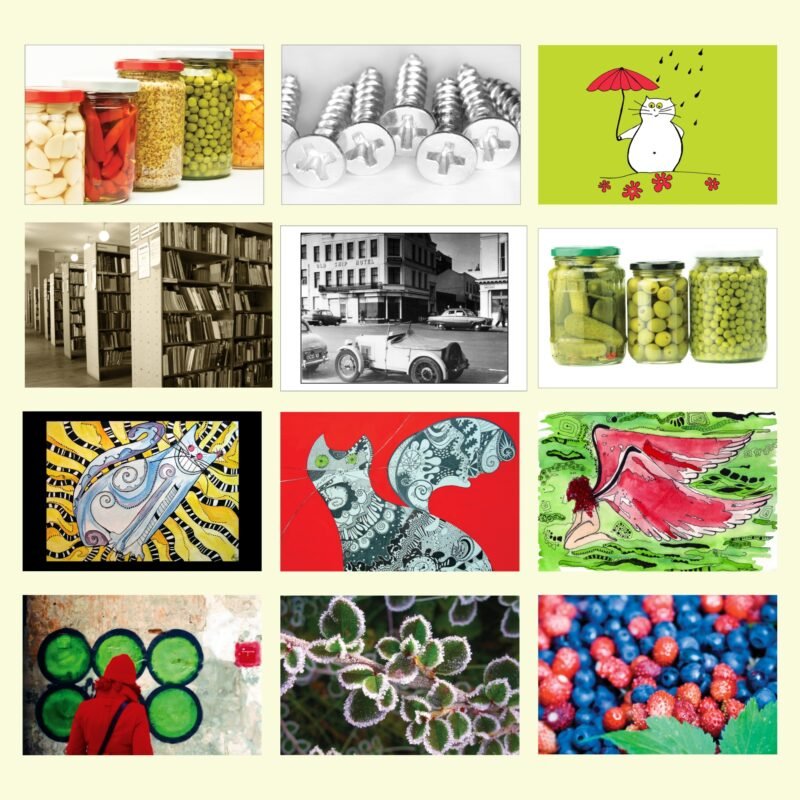
Here I’d place a small collage of old postcards from the early years of the shop (almost 15 years ago). Designs that were printed with care but quietly retired later.
This part of my archive is a reminder that growth isn’t linear.
What actually happens to postcards that don’t sell
They don’t disappear overnight.
Some move to the Sale section. Some are included in grab-bag postcard sets (I run grab-bag sales twice a year). Some quietly retire and make space for new work, I use them as a thank you cards. Occasionally, a design that once struggled suddenly finds its audience in a different context.
Nothing is wasted. The shop is not a machine that erases its past, it’s more like an evolving archive.
There’s also a part of this process that isn’t particularly romantic. Unsold postcards hurt financially. Every design that doesn’t move ties up money, storage space, and time. That part is very real, even if it’s not something I usually talk about out loud.
At the same time, releasing only guaranteed bestsellers would make the shop predictable, and honestly, a bit boring. Over the years, I’ve learned that the most popular postcards quietly support the less popular ones. Bestsellers create room for experiments, for quieter designs, for ideas that don’t shout but still deserve to exist.
That balance matters to me. Not every postcard needs to justify itself immediately. Some are carried by others until they find their place, and some never fully do, but they still shape the shop into something more than a list of top performers.
Postcards Collage – middle period
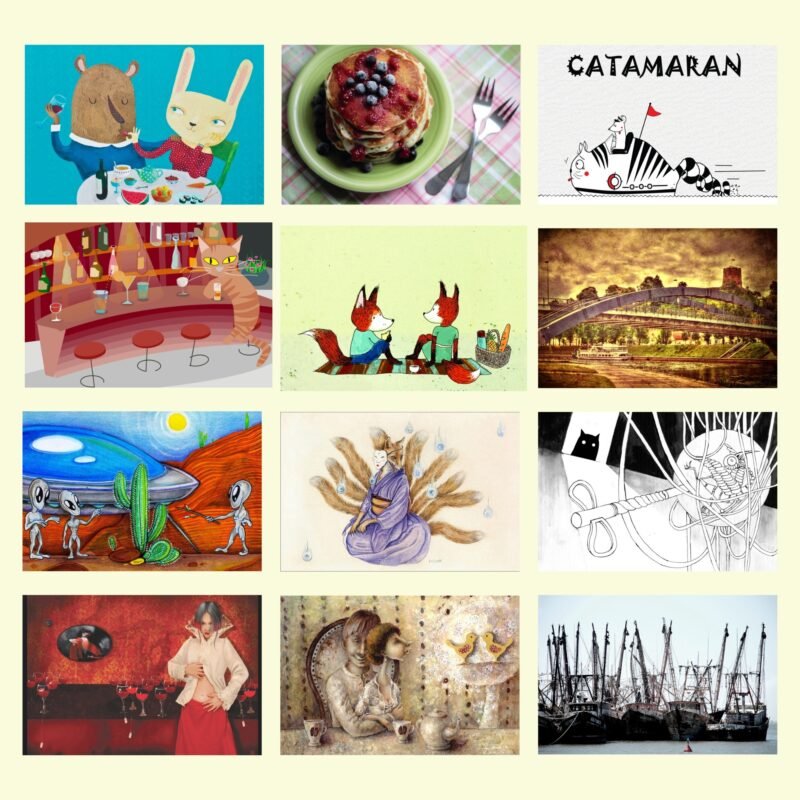
Here I’d place a second collage with postcards from different themes and periods, showing variety rather than “failure”. All these postcards weren’t popular.
This is also where I learned something important: some postcards were sent only a few times, but those few times were exactly right.
Why this changed how I run the shop today
Watching which postcards don’t find their audience has shaped my decisions more than the bestsellers ever did.
It’s one of the reasons I now prefer:
- fewer, more thoughtful releases
- collections instead of isolated designs
- quieter updates instead of constant launches
It’s also why I’m more comfortable letting some designs live slowly or leave without forcing them to perform.
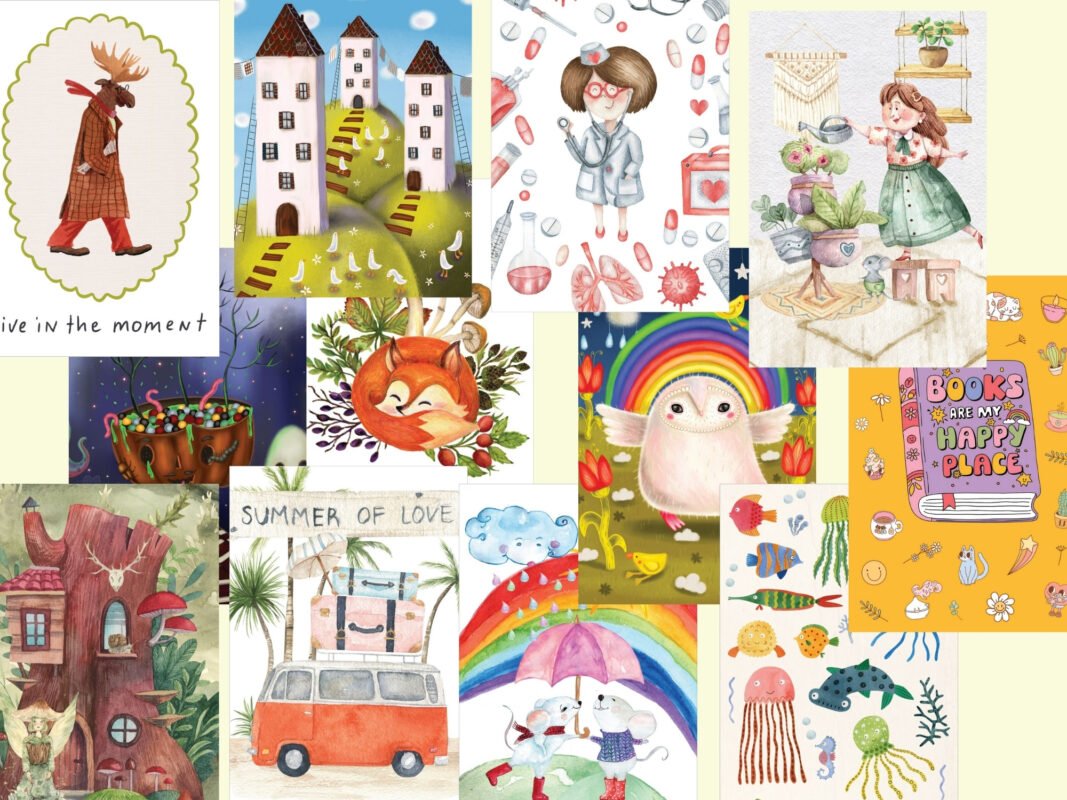
Postcard Collage – recent years
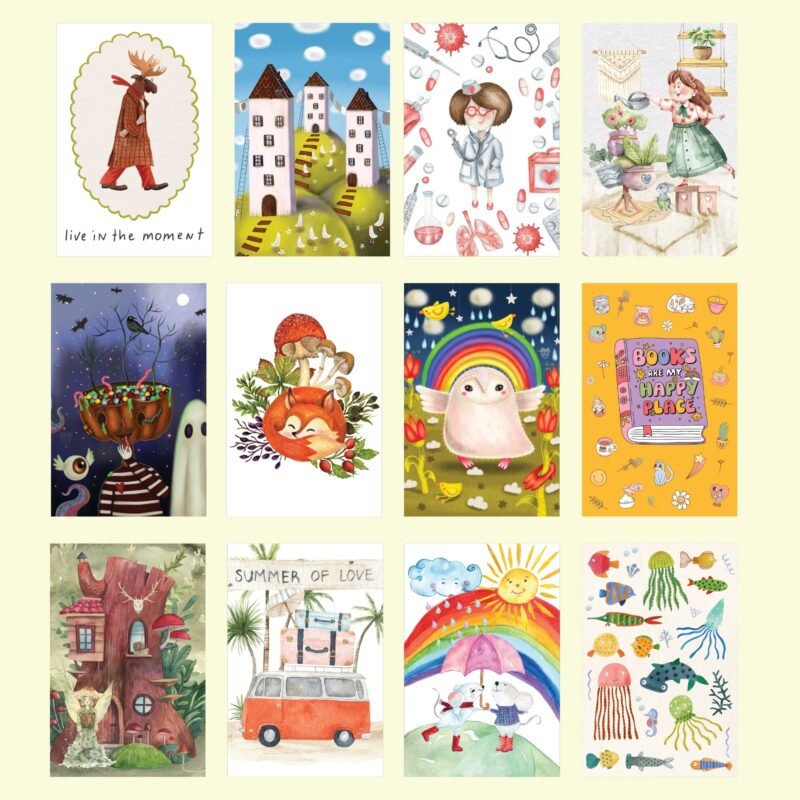
Here I’d place a collage of more recent designs that didn’t quite take off.
In the end, it’s not a failure
A postcard that doesn’t sell much isn’t a mistake. It’s information.
I’ve also learned that trying to predict success too precisely is exhausting. At some point, you either allow yourself to release things without guarantees, or you stop enjoying the process altogether. I’m not interested in running a shop made only of safe bets.
Not everything needs to be a bestseller. Some things just need to exist for the right person to find them, even if that takes time.
Even though I now work more with collections, there will always be postcards I choose to release simply because I feel they should exist. Sometimes I already know they probably won’t be bestsellers, and that’s fine.
There’s room for different interpretations, different moods, and different kinds of postcards to coexist. Not every design needs to please everyone. Sometimes it’s enough that it speaks clearly to a few, or simply feels right to release, even knowing it will live quietly.
—-
If you’re just starting with Postcrossing, you can also explore my Postcrossing Starter Guide.
You might also like
Best Postcard Themes for Postcrossing Profiles
What to Write on a Postcrossing Postcard? (10 real ideas)
The Best Postcrossing Tips for Beginners