Because nobody has ever stopped smiling over a postcard that wasn’t “interesting enough.”
One of the funniest things about Postcrossing is that people often worry far more about writing a postcard than the person receiving it ever will.
I’ve been sending postcards for more than 18 years, and after running Favorite Postcard since 2011, I’ve read thousands of Postcrossing profiles, received postcards from all over the world, and talked to countless people who all seem to worry about exactly the same things.
The good news?
Most of those worries simply don’t matter.
The person receiving your postcard is usually happy for one very simple reason: they found something real in their mailbox.
In fact, many of the things people overthink are exactly the things that make postcards feel personal.
If you’ve ever found yourself staring at a blank postcard, wondering whether what you’re about to write is “good enough”, this article is for you.
Over the years, I’ve noticed the same worries coming up again and again. Some come from beginners, others from people who have been sending postcards for years. So let’s go through them one by one and see why most of them really aren’t worth worrying about.
Here’s what people worry about most:
1. “My English Isn’t Perfect.”
This is probably the most common worry I come across. Many people begin their postcards with something like:
“Sorry for my bad English.”
And every time I read that, I think exactly the same thing: You didn’t need to apologize.
Postcrossing is an international community. Most of us are writing in a language that isn’t our first one, and everyone knows it. A missing article, the wrong verb tense, or a slightly awkward sentence isn’t going to ruin anyone’s day.
I’d much rather receive five genuine sentences with a few mistakes than one perfectly polished paragraph that sounds like it came from a translation tool.
Besides, some of my favourite postcards contain tiny language mistakes. Not because the mistakes are funny, but because they remind me there’s a real person sitting at a table somewhere, writing that postcard just for me.

2. “My Life Isn’t Interesting Enough.”
You don’t need to climb mountains every weekend, you don’t need to travel every month.
And you definitely don’t need dramatic stories.
Some of my favourite postcards have been about things like:
- finally finding a good bakery
- spending the afternoon reading
- planting tomatoes
- walking the dog
- making pancakes on a Sunday morning
Ordinary life is surprisingly interesting because it’s different everywhere.
One of the most memorable postcards I’ve ever received didn’t tell a dramatic story at all. It was simply a list of things that made the sender happy: coffee, clouds, snow, paper, the colour red, jeans… Only at the very end did they explain what the list actually was: a list of things which are making the person happy, if you are interested.
I’ve never forgotten that postcard. In fact, I’ve borrowed the idea myself more than once.
What’s ordinary to you might be completely new to someone on the other side of the world. Your rainy Tuesday is somebody else’s curiosity, just like their everyday life is a glimpse into a world you’ll probably never experience yourself.
Everyday Life and Small Moments Postcards themselves can be good hints for writing topics.
3. “I Have Nothing Interesting To Say.”
This usually happens about five minutes after you pick up the pen.
You stare at the postcard. The postcard stares back. Nothing happens. I know.
The problem is that you’re trying to think of something interesting. That’s a surprisingly high standard for a Tuesday evening. Instead, think of one small thing that happened today.
Rather than writing:
“I had a nice day.”
Try something like:
“Today I finally finished the mystery novel that had been sitting on my bedside table for two months.”
Or:
“I was planning to clean the house, but somehow ended up baking cookies instead.”
Tiny details are what make postcards memorable because they sound like they could only have come from one person.
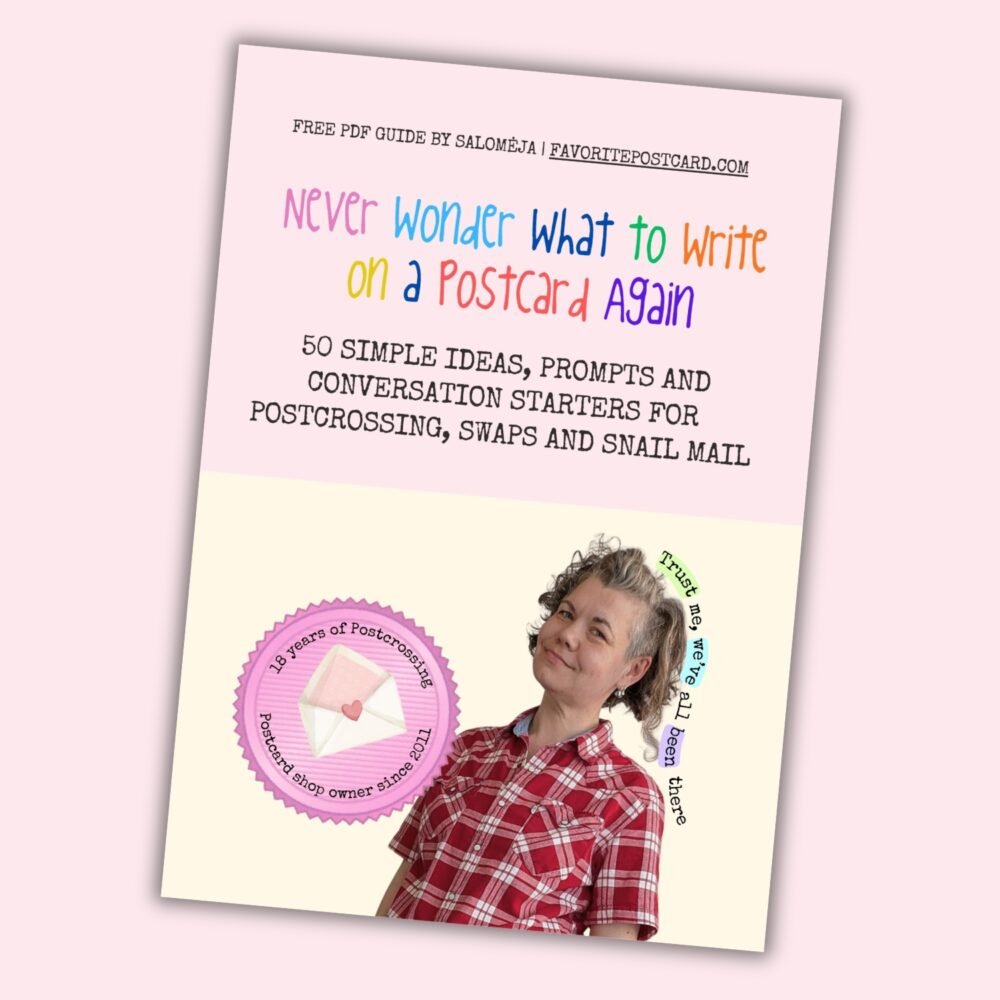
If you’re completely stuck, I also put together a free guide with 50 Things to Write on a Postcard.
4. “My Handwriting Is Terrible.”
Mine changes depending on:
- the pen,
- the paper,
- how much coffee I’ve had,
- and whether Bitė suddenly decides the postcard isn’t getting enough attention.
Honestly, I don’t think I’ve ever looked at a postcard and thought, “What a shame… the handwriting isn’t elegant enough.”
As long as I can read it, I’m happy.
And judging by the postcards I’ve received over the last 18 years, I’m definitely not the only one.
5. “The Postcard Is Too Small.”
Ironically, many people worry that postcards don’t have enough space.
Then they receive one with just three lines, and love it anyway. A postcard isn’t supposed to tell your entire life story. It’s a glimpse, not a biography.
Sometimes one small moment is all it takes.
For example:
“It’s raining today, so I’m writing postcards while drinking coffee and listening to the birds outside my window.”
That’s already enough for someone on the other side of the world to picture your afternoon. Most of us would rather read one real moment than a tiny essay squeezed into every available millimetre.
6. “I Need To Write Something Deep.”
You really don’t. We convince ourselves that if a postcard is travelling halfway around the world, it should probably contain a profound thought about life. In reality, some of the postcards I’ve smiled at the most said things like:
“Today’s lunch was surprisingly good.”
or
“I finally cleaned my desk after ignoring it for weeks.”
Neither sentence is particularly deep, but both sound like they were written by a real person with a real daily life.
A postcard doesn’t have to change someone’s perspective. Sometimes it’s enough to share one tiny moment that made up your day. We happily share random moments in Instagram Stories every day, so why not share one on a postcard too?
And if your next question is still “but what do I actually write?”, I put together a practical guide with postcard message ideas and examples you can borrow or adapt.
7. “The Recipient Will Think I’m Boring.”
Here’s something I’ve noticed after more than 18 years of Postcrossing. People rarely remember postcards because the story was extraordinary. They remember them because they felt genuine.
A postcard that only says “Happy Postcrossing!” doesn’t tell me anything about the person who wrote it. “Thank you for swaping” without other text is boring. “Happy postcrossing! I was waiting for a profile that likes cats because I can’t wait to send this postcard, which is the funniest in my collection.” is not boring, it suddenly feels completely different.
The funny thing is that we’re usually much harsher judges of our own stories than the people reading them. What feels ordinary to you is often exactly the kind of glimpse into another life that makes Postcrossing so enjoyable.
8. “I Have To Match Their Profile Perfectly.”
Reading someone’s profile is definitely worth it.
It helps you choose a postcard, avoid obvious dislikes, and often gives you an easy conversation starter.
But don’t treat it like an exam where you have to score 100%.
Some profiles contain twenty favourite themes, fifteen countries they collect, three pages of dislikes, and a small novel about their hobbies.
Relax.
If you connect with just one thing they mentioned, that’s already a great place to start.
And if you end up choosing a postcard that isn’t exactly on their wishlist, a simple sentence explaining why you picked it often makes all the difference.
“I saw you like books, and this little café reminded me of somewhere I’d happily spend an entire afternoon reading.”
That’s much more personal than trying to tick every box on a very long list.
9. “I Need To Sound Clever.”
This one always makes me smile.
People sometimes spend ten minutes trying to come up with the perfect sentence, as if the recipient is secretly grading their postcard.
Meanwhile, as I mentioned, one of the most memorable postcards I’ve ever received simply listed random words:
- coffee
- clouds
- paper
- snow
- red
- jeans
The list went on for almost the entire postcard. At the very end, the sender added:
“These are small things that make me happy.”
I still remember that postcard years later. It felt honest and original. I use this very often in various variations, like a list of words reflecting my current mood. And that’s what people usually remember.
Not the perfect sentence, but the little things that make someone sound like themselves.
10. “Every Postcard Has To Be Different.”
After you’ve sent hundreds of postcards, you’ll probably repeat yourself. That’s completely normal.
You’ll mention your dog more than once. You’ll recommend the same favourite book. You’ll complain about the weather far more often than you’d like to admit. And you’ll probably tell at least a dozen people that spring is your favourite season.
Here’s the important part:
The person receiving your postcard hasn’t read the previous two hundred. To them, everything you write is new. So don’t put unnecessary pressure on yourself to invent something completely original every single time.
You’re not writing for the entire Postcrossing community. You’re writing for one person.
The Best Postcards Usually Feel Like Conversations
The longer I spend in the Postcrossing community, the more convinced I become that people don’t remember postcards because they were perfectly written, but because they sounded like they were written by a real person.
A few genuine sentences will almost always beat a carefully crafted paragraph that doesn’t sound like you. So next time you’re staring at a blank postcard, don’t ask yourself:
“What should I write?”
Instead ask:
“What would I tell a friend if they were sitting across the table from me right now?”
Maybe it’s something about your day. Maybe it’s a complaint about the weather. Maybe it’s a recommendation for a good bakery. Maybe it’s just a story about your dog doing something ridiculous.
Whatever it is, it’s probably more than enough. And if all else fails, remember this:
Nobody has ever stopped smiling over a postcard because it wasn’t interesting enough.
Still Looking For Ideas?
If reading this article made you realize that you sometimes overthink your postcards, you’re definitely not the only one.
That’s exactly why I created 50 Things to Write on a Postcard – a free guide filled with simple prompts, conversation starters, and little ideas to help you get past that intimidating blank space.
It doesn’t matter if you’re writing your very first Postcrossing postcard or your five thousandth, I hope it makes the process feel a little easier… and a lot more fun.
👉Download my free guide 50 Things to Write on a Postcard.
You might also enjoy:
- Why Is It So Hard to Know What to Write on a Postcard?
- Postcrossing Starter Guide
- Everything for Postcrossing
- Postcard Collection
- Postcard message ideas